How British Designers Are Dropping Hem Lines
by Logan Ross
Brilliant British brands Burberry, Alexander McQueen, and Paul Smith brought their Spring/Summer 2017 collections to the forefront of the fashion world’s attention with one common theme, the elongated silhouette.
All three of these British designers set out to redefine how pants should fit for men starting this spring. For what seems like forever now, men’s pants have all looked the same – skinny fit through the thighs and upper leg, with an extreme taper below the knee. Men’s pants have had their hem’s break line nowhere to be found, up high on the ankle shifting focus onto the shoe, framing them like a work of art.
This past fall, however, the pants have taken over. Perhaps hem lines are tired of holding themselves up so high on men’s legs for so long, and if you’ve still got a bit of a soft spot for Isaac Newton, you might remember him saying something about “what goes up must come down”. Fashion Network’s writer Dominique Muret agrees, writing that most menswear designers made it so “trousers hung unendingly and bunched at the feet,” and that it added thematically “to the lengthiness,” this season featured.
With elongated trousers being the common silhouette between each brand, the themes were born from a similar idea as well – British heritage.
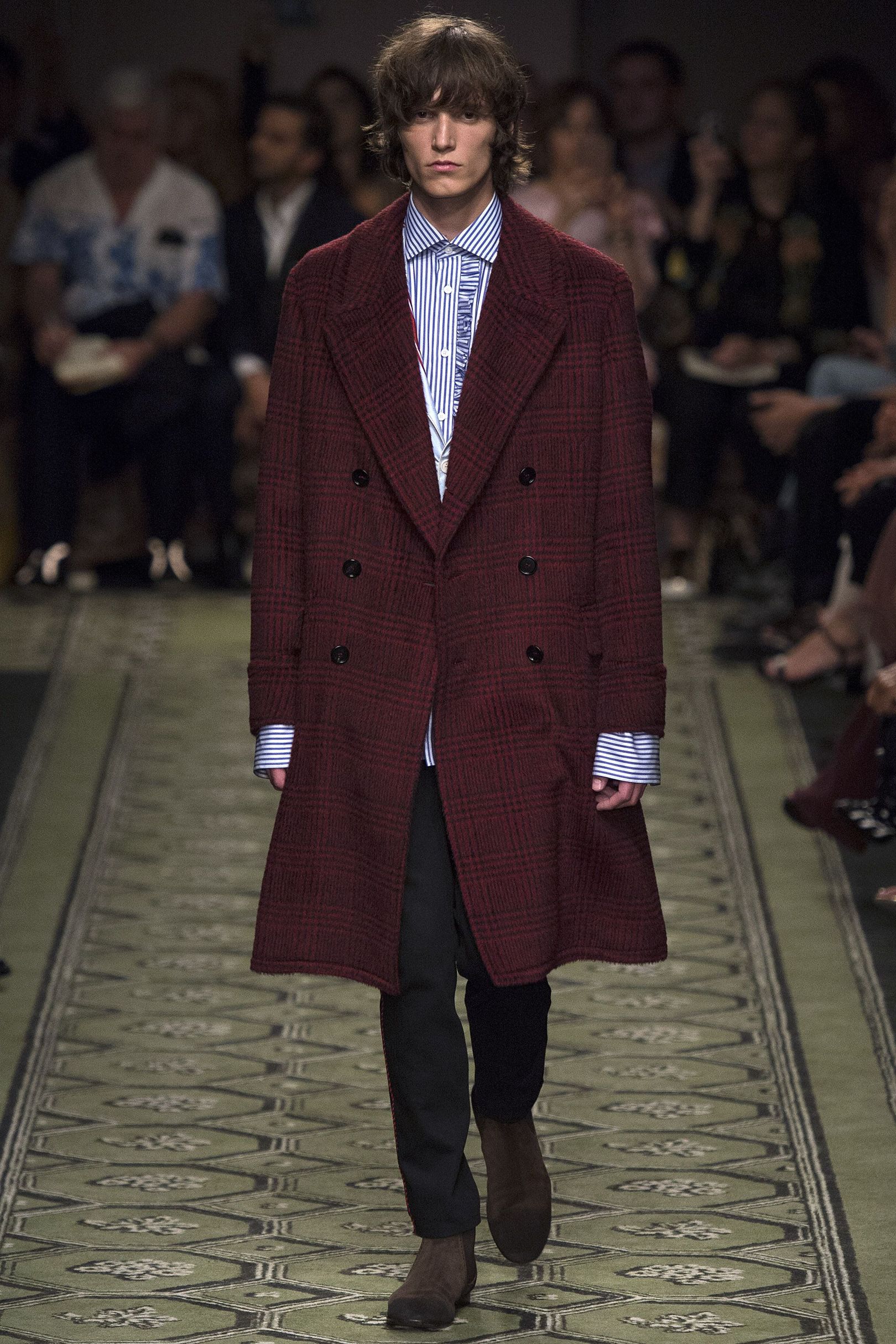
Burberry’s showing of their Spring/Summer collection for 2017 pulled styles inspired from the Elizabethan era, giving them a grungy yet glamorous silhouette. The overall theme of Burberry’s show was the Elizabethan Rocker.


Burberry’s palettes were mostly dark, and length was a standout. The most obvious and common silhouette featured were when sleeves covered hands, and trousers fell to a large break on the shoes. Ruffles featured on shirt cuffs and collars only added to that perception of length, and played heavily on the Elizabethan time period.


However, studded shirts and shearling liners added to outerwear gave that new-age rocker feel in spurts, pairing masterfully with the older, heritage theme. Patent fabrics – usually layered secondary or tertiary, and exposing a sheen – were tastefully contrasted with dull and matte finishes in their outfit compositions.
If one man in the fashion industry personifies colour, it is indisputably Paul Smith. This year Smith played on possibly his homeland’s most influential musical era, the Britpop dominance of the 1960s. Smith uses colours and cuts unmistakably reminiscent of this time period, such as bright yellows, reds, oranges, and greens to showcase his vision of mid-century modern Britpop.
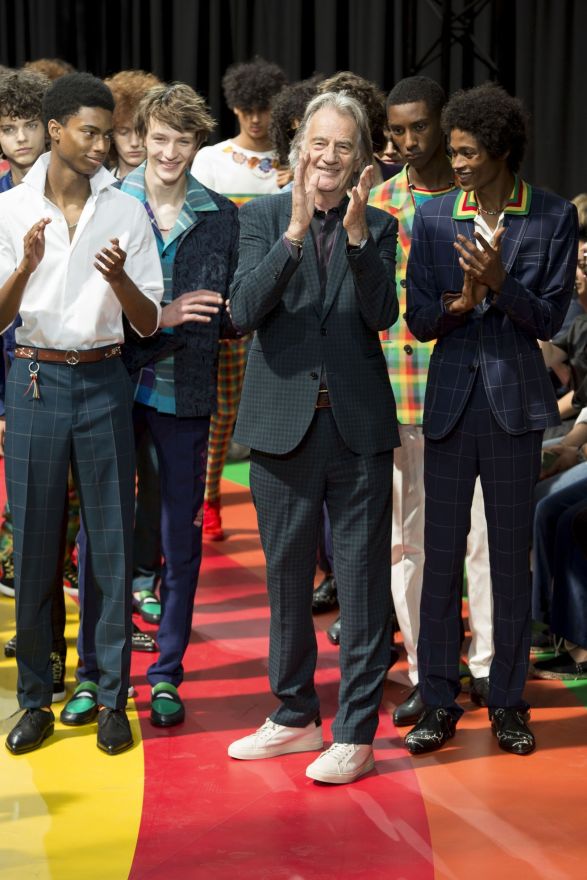
British designer Paul Smith pictured (Middle)
The suit was used heavily as well in Smith’s show, but as they were worn by Britpop icons in the 60’s, they had that cool and casual essence to their structure.Visibly soft fabrics and suit padding added to the casualness of the vibrant colours, but nothing defined the laid-back theme more than the trousers’ length pooling around the shoes.


Alexander McQueen yet again had a British heritage theme to their collection, re-imagining 1930’s British tailoring in a darker, more gothic tone. Black pinstriped suits were worn along with off-white day-suits, however each outfit had a clear darkness to them. Highly structured jackets included very rigid padding in the chest and shoulder pieces, creating a sense of authority and power to the models. Accessories such as lip piercings and jewellery gave the collection that grungy undertone.


While McQueen’s collection was easily the darkest of the three British brands, not only in terms of colour but emotion, the designer didn’t miss out on the trouser trend. You guessed it, lots of extra fabric pooled around the ankles and resting on top of the feet of the models featured wearing the pants in this collection.\
Images courtesy of gq-magazine.co.uk

 HYPE MAG